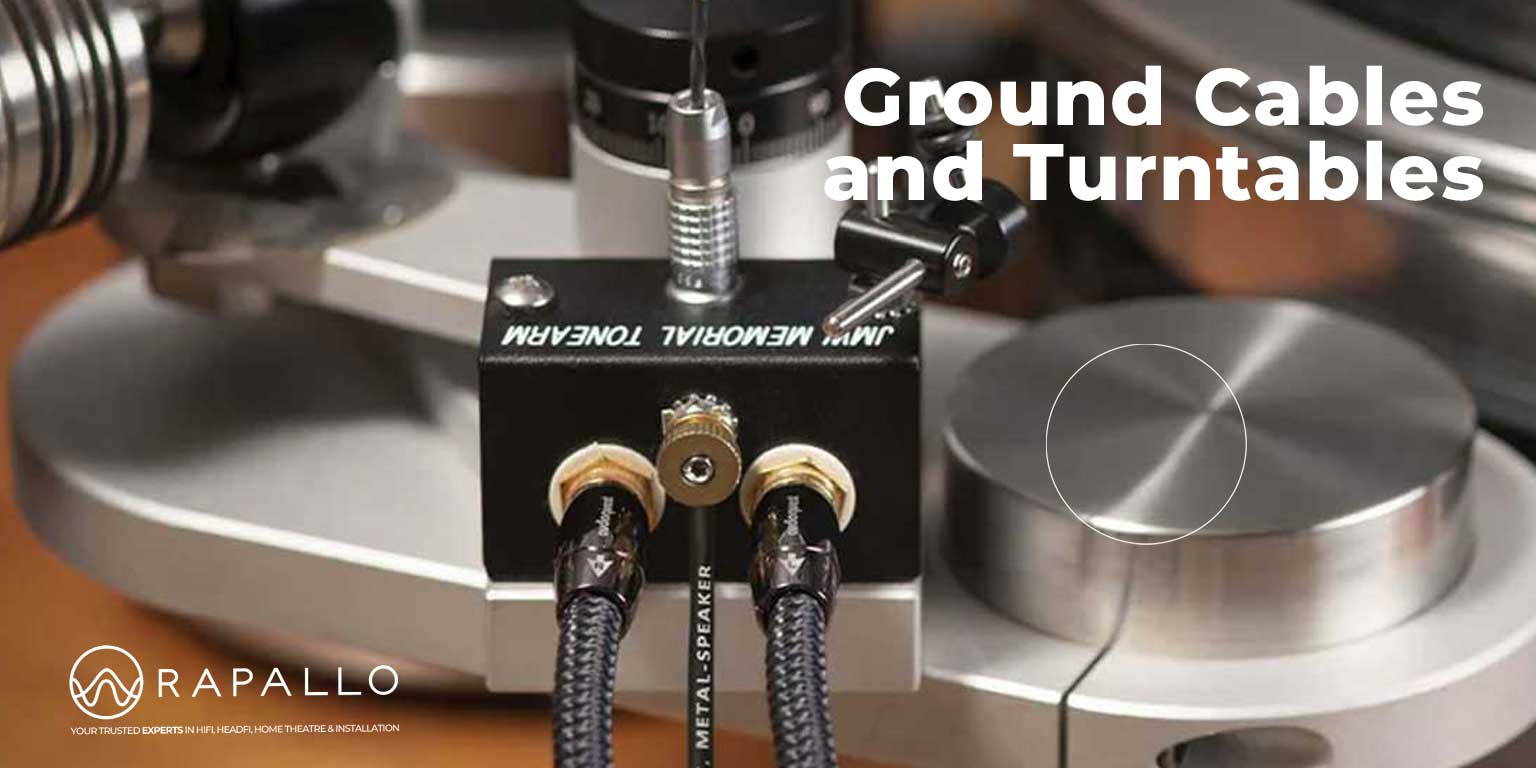
Ground Cables and Turntables
Estimated reading time: 8 minutes
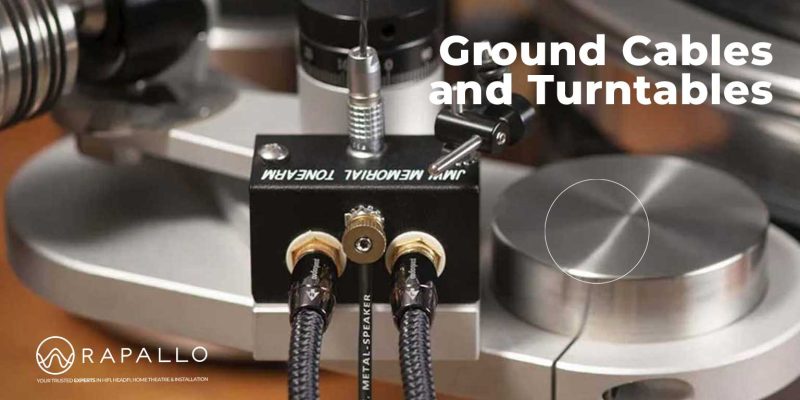
Ground Cables and Turntables, time to separate electrical fact from audiophile folklore – at least we will try.
Among the many rituals of vinyl playback, few inspire as much confusion and debate as the humble ground cable. For something that often looks like an afterthought, a thin wire dangling from the back of a turntable, it carries a reputation that ranges from “absolutely essential” to “snake oil in copper form.”
Some listeners swear that upgrading or tweaking their ground wire transformed their system’s noise floor and spatial clarity. Others argue that if your system is properly designed, the ground cable should be sonically irrelevant.
As usual in audio, the truth sits somewhere between electrical engineering and practical experience. Understanding what a ground cable actually does and what it cannot do acn save you frustration, money, and countless hours chasing phantom hum.
This article takes a deep dive into the role of grounding in turntable systems, why ground cables exist, how they interact with cartridges and phono stages, and when attention to grounding really matters.
Key Takeaways
- Ground cables play a critical role in vinyl playback by providing a common reference point between the turntable and phono preamp.
- Some turntables don’t need ground wires due to design choices, while others can experience problems if mismatched with grounding schemes.
- Ground loops can occur with multiple grounding paths, leading to unwanted noise and are not prevented by simply adding more ground cables.
- A solidly constructed ground cable generally suffices for most systems; fancy cables may not justify their cost and can lead to confusion.
- Proper grounding contributes to system hygiene, allowing the true sound signal to emerge without contamination, but grounding should not be seen as a magical fix.

Why Turntables Are Uniquely Sensitive
To understand grounding, you have to start with the signal itself.
A phono cartridge outputs an extraordinarily small voltage. A typical moving magnet (MM) cartridge produces around 4–6 mV; many moving coil (MC) cartridges output less than 0.5 mV. This signal is then boosted by 40–70 dB in the phono stage before it ever reaches your line-level preamp.
At these microscopic levels, noise is the enemy. Any unwanted electromagnetic interference, voltage potential difference, or circulating current can be amplified right along with the music. This is why vinyl playback is so sensitive to cable routing, transformer proximity, and crucially… grounding.
Unlike digital sources or line-level components, turntables are mechanical devices with exposed metal parts: tonearms, bearings, platters, and motors. These elements can act as antennas, collecting interference if they are not referenced to a stable electrical ground.
What a Ground Cable Actually Does
Despite the mythology, a turntable ground cable is not there to “drain noise” or “improve clarity” in some abstract way. Its job is far more specific and far less mystical.
A ground cable provides a common reference potential between the turntable and the phono preamp. In other words, it ensures that the metal parts of the turntable and the ground of the phono stage sit at the same electrical zero point.
Without this shared reference, small voltage differences can exist between components. These differences can cause circulating currents known as ground loops, or allow interference to enter the signal path. The audible result is usually a low-frequency hum (50 or 60 Hz, depending on your region), sometimes accompanied by higher-frequency buzz.
The ground cable is not part of the audio signal path itself. Ideally, no music signal flows through it at all. When everything is working correctly, the ground wire is effectively silent and invisible.
Why Some Turntables Need Ground Wires—and Others Don’t
If grounding is so critical, why do some turntables not include a separate ground cable at all?
The answer lies in design philosophy.
Many turntables, particularly Japanese models from the 1970s and 1980s, used a separate chassis ground wire because the signal ground and chassis ground were isolated by design. The ground wire tied the tonearm and metalwork to the phono stage, reducing the chance of hum.
Some modern turntables, especially those with built-in phono preamps or fully isolated tonearm wiring internally bond the chassis ground to the signal ground. In these designs, the RCA cables themselves carry the ground reference, making an external ground wire redundant.
Neither approach is inherently superior. Problems arise when a system mixes grounding schemes in unexpected ways. A turntable designed for a separate ground wire may hum loudly if that wire is disconnected. Conversely, adding an unnecessary ground connection to a turntable that already bonds its grounds internally can actually create a ground loop.
Ground Loops: The Audiophile’s Most Common Enemy
A ground loop occurs when there are multiple paths to ground between components. Instead of a single reference point, current circulates in a loop, inducing hum.
In a vinyl system, ground loops often occur when:
- The turntable chassis is grounded through both the RCA cables and a separate ground wire
- The phono preamp and amplifier are grounded through different outlets
- Additional components (DACs, streamers, cable TV boxes) introduce alternate ground paths
Importantly, the presence of a ground cable does not prevent ground loops. In some cases, it causes them.
This is why blindly adding ground wires “just in case” is a recipe for frustration. Proper grounding is about simplicity and intention, not redundancy.
Does the Quality of the Ground Cable Matter?
Here’s where audiophile debate gets heated.
From a strict electrical engineering perspective, a ground wire only needs to be conductive enough to maintain a stable reference potential. It does not carry an audio signal, so its resistance, capacitance, and dielectric properties should not affect sound quality, assuming it is doing its job.
In practice, however, things get complicated.
Poor-quality ground wires can suffer from loose connections, oxidation, or insufficient shielding in electrically noisy environments. In extreme cases, a flimsy ground wire can act as an antenna rather than a sink, injecting interference instead of eliminating it.
That said, the leap from “well-made ground wire” to “audiophile ground cable costing hundreds of dollars” is difficult to justify technically. Improvements people report are often system-dependent and may result from fixing a bad connection rather than enhancing an already functional one.
A solid, well-terminated copper wire of appropriate gauge is sufficient for the vast majority of systems.
Recommended products
-
AudioQuest Black Hole GroundGoody RF-Dissipating Ground Wire
$109.00 inc GST -

AudioQuest ThunderBird GroundGoody RF-Dissipating Ground Wire
$229.00 inc GST -
AudioQuest Dragon GroundGoody RF-Dissipating Ground Wire
$799.00 inc GST
Tonearms, Bearings, and Hidden Ground Paths
One often-overlooked aspect of grounding is the tonearm itself.
Some tonearms ground the arm tube, bearings, and headshell through the left-channel signal return. Others provide a separate arm ground wire. Still others float the arm entirely and rely on chassis grounding.
This matters because tonearm bearings are a common source of noise. If the bearings are not properly grounded, they can pick up mechanical vibration and electromagnetic interference, injecting it directly into the cartridge signal.
When diagnosing hum, it’s useful to know whether your tonearm is grounded separately or through the signal path. This information is often buried in service manuals rather than user guides, but it can explain why some grounding tweaks work and others fail.

Practical Advice: Getting Grounding Right
Time needed: 2 hours
For all the theory, grounding ultimately comes down to careful setup. Here are practical guidelines that work in most systems we have spent time on:
- Start simple
Connect the turntable exactly as the manufacturer recommends. Use the supplied ground wire if one is provided.
- Listen for hum with the stylus off the record
Turn up the volume with no music playing. A properly grounded system should be nearly silent, aside from faint hiss at high gain.
- Experiment methodically
If hum is present, try disconnecting the ground wire or grounding the turntable chassis to a different point, but here is the key lesson, change only one thing at a time.
- Use a single grounding reference
Ideally, the turntable, phono stage, and amplifier should all reference the same ground point, either through a star-ground configuration or a shared power outlet
- Check physical connections
Loose spade connectors and oxidized ground posts cause more problems than cable metallurgy ever will.
When Grounding Tweaks Make a Real Difference
There are scenarios where grounding improvements can yield audible benefits, not by “enhancing the sound,” but by removing noise that masks it.
High-gain moving coil systems are particularly sensitive. So are setups in urban environments with significant RF interference. In these cases, cleaning up grounding can lower the noise floor enough to reveal low-level detail and ambience that was previously obscured.
But this is subtraction, not addition. Grounding does not add warmth, widen soundstage, or improve timing. It simply allows the cartridge’s signal to emerge without contamination.
Grounding as System Hygiene, Not Magic
In the end, ground cables belong in the same category as proper alignment, clean records, and vibration control. They are part of system hygiene—essential, but not glamorous.
A correctly grounded turntable disappears electrically, leaving only the fragile, beautiful signal carved into the groove. When grounding is wrong, it demands attention. When it’s right, you never think about it again.
And that, perhaps, is the highest compliment you can pay a piece of wire.
FAQ’s
No. Some turntables bond chassis and signal ground internally and rely on the RCA cables. Others require a separate ground wire—check the manufacturer’s design.
A ground cable doesn’t improve sound directly, but correct grounding can reduce hum and noise, allowing more low-level detail to be heard.
Hum is usually caused by ground loops, missing grounds, poor connections, or electromagnetic interference amplified by the phono stage.
In most systems, no. A well-made, properly terminated copper wire works just as effectively as costly aftermarket options.
Typically to the ground post on your phono preamp. If hum persists, experimentation may be needed, but always change one connection at a time.
- Setting Up a Projector for a Golf Simulator
 A great golf simulator isn’t just about the launch monitor and software, the projector is what sells the illusion. The…
 - What Streaming Platform Should I Use?
 PlayFi vs HEOS vs MusicCast vs BluOS: Which Whole-Home Audio System Is Right for You? Imagine this: you wake up,…
 - HDMI Cables Explained
 HDMI Cables Explained: What’s the Difference, and what AudioQuest Cables should you use?? Walk into any electronics store or browse…
 - How To Set Up An Audiophile Network Switch
 How to Set Up an Audiophile Network Switch: A Guide for Better Sound Quality As high-resolution music streaming becomes the…
 - Ground Cables and Turntables
 Ground Cables and Turntables, time to separate electrical fact from audiophile folklore – at least we will try. Among the…
 - What Are Planar Magnetic Headphones?
 So what are Planar Magnetic Headphones? Here is our guide for curious HeadFi listeners. If you’ve spent any time browsing…
 NZ AV specialists available to help before or after your purchase
 1,750+ verified product reviews from genuine NZ verified purchasers
 Secure checkout & local warranty, we look after you
 NZ price match on identical products so you know you are getting the right price