


Description
About the Dynaudio LYD 48 3-Way Active Studio Monitor
The Dynaudio LYD 48 3-Way Active Studio Monitor’s dedicated midrange is a defining feature. It handles the region where vocals and many instruments carry their character, helping you assess balance and separation in busy recordings.
DSP adjustments allow you to tailor bass extension, placement compensation and tonal balance. Meanwhile, analogue XLR and RCA inputs make connection straightforward.
The listing includes a left-and-right stereo pair. Choose black or white, and contact us to confirm availability before ordering.
View Manual >> View Brochure >> View Dynaudio Professional >>
→ What We Think About The Dynaudio LYD 48
The LYD 48 puts the most revealing part of a recording at the centre of its design. For anyone working with layered vocals, guitars or dense electronic arrangements, its dedicated midrange makes it an appealing step into three-way monitoring.
Reviewers consistently highlight its imaging and ability to expose mix problems without making long sessions unpleasant. That combination matters: useful monitors should help you make confident decisions while remaining comfortable to work with.
We would build a system around careful positioning, stable supports and a dependable volume controller. Allow enough desk or stand width for the horizontal cabinets, and budget for acoustic treatment where needed. The rear-panel settings are useful finishing adjustments, but the room remains part of what you hear.
→ Suggested System Match
A good LYD 48 system starts with convenient control of both speakers together. Choose an interface, monitor controller or preamplifier that provides predictable volume adjustment and suitable line outputs.
The optional Dynaudio 18S is a natural partner when you need to assess deeper bass. It includes integration settings for LYD monitors, which provide a useful starting point. Correct positioning and level adjustment are still necessary.
For stereo placement, begin with equal distances between the listening position and each speaker. Keep nearby surfaces as symmetrical as practical. Then use familiar recordings to assess the result before making tonal adjustments.
Recommended With This Product
- Dynaudio 18S Subwoofer: Adds deeper bass monitoring with settings intended to integrate with LYD speakers.
- Balanced XLR Interconnects: Suitable for compatible preamplifiers and monitor controllers.
- Balanced TRS-to-XLR Cables: Connect interfaces that use quarter-inch balanced line outputs.
- Monitor Stands: Provide secure support and more freedom to position the speakers.
- Isolation Platforms: Useful where monitors must sit on a desk or console; select for cabinet size and weight.
- Acoustic Treatment: Helps control reflections and bass unevenness that can obscure mix decisions.
- Measurement Microphone: Useful for evaluating placement and identifying room-related response problems.
→ The Dynaudio LYD 48 Monitor Is Ideal For
- Recording and mixing studios
- Vocal production and editing
- Electronic music, hip-hop and pop production
- Detailed assessment of layered arrangements
- Post-production and dialogue work
- Dedicated desktop listening systems
- Buyers moving into three-way monitoring
- Systems needing both professional and domestic analogue connectivity
- Producers who work for extended listening sessions
Frequently Asked Questions
- What is the Dynaudio LYD 48?
The LYD 48 is a powered three-way studio monitor. Its separate bass, midrange and treble drivers make it suitable for recording, mixing, editing and critical music listening. - Does this listing include a pair?
Rapallo’s listing offers a left-and-right pair in black or white. Each speaker is individually packaged, so the manufacturer’s one-speaker box quantity should not be confused with the Rapallo bundle. - Does the LYD 48 need an external amplifier?
Every driver has its own built-in amplifier. You need a suitable line-level source and a convenient way to control the volume of both speakers together. - Why choose a three-way monitor?
A dedicated midrange separates much of the vocal and instrumental range from the bass driver’s workload. This can help when assessing overlapping parts, although overall results also depend on the room and placement. - Can I connect the monitors to an audio interface?
Use the interface’s monitor or line outputs. Balanced connections are a practical choice, with XLR or TRS-to-XLR cables selected to match the interface. - Can I use the LYD 48 for home hi-fi listening?
Connect a suitable preamplifier or variable-output DAC through XLR or RCA. A fixed-output source requires a separate volume controller. - Does it accept USB or optical audio?
Its inputs are analogue. A computer or digital source needs an audio interface or DAC before the signal reaches the speakers. - Should the LYD 48 sit horizontally?
Dynaudio designed this model for horizontal placement. Start with the woofers towards the inside of the stereo pair, then follow the manual’s positioning guidance. - How close should I sit to the speakers?
Dynaudio suggests approximately 1.5–2.5 metres for the LYD 48. Aim the speakers towards the listening position and maintain equal distances to each cabinet. - What does Bass Extension change?
It trades low-frequency reach against maximum output. The −10Hz setting extends bass, while +10Hz reduces extension and increases available headroom. - Does the LYD 48 include automatic room correction?
Its DSP settings are manual adjustments. They can help refine the response, but they do not measure the room or automatically correct its acoustics. - Do I need a subwoofer with the LYD 48?
Not every system needs one. For deeper bass assessment, the Dynaudio 18S offers a useful upgrade path with LYD integration settings. Allow time to adjust its placement and level. - Can the monitors go into standby automatically?
Auto mode places the amplification into a power-saving state when unused and wakes it when audio is detected. An always-on setting is also available. - Can I audition the LYD 48 at Rapallo?
Contact Rapallo to confirm demonstration availability, we may be able to get a pair in to demo. The team can also help assess whether its size, connections and listening-distance requirements suit your room.
Key Features
Three-Way Driver Design
Separate bass, midrange and treble drivers divide the workload across the frequency range. This gives the LYD 48 a dedicated driver for the critical middle frequencies, where vocal intelligibility and instrumental character are especially important.
Dedicated 4-Inch Midrange
The MSP midrange operates between the crossover points at 460Hz and 5.5kHz. This broad coverage keeps much of the vocal and instrumental range within one driver, supporting clear assessment of complex arrangements.
8-Inch MSP Woofer
Dynaudio’s Magnesium Silicate Polymer woofer handles the low frequencies. Combined with the rear-ported enclosure, it provides the foundation for judging kick drums, bass guitar and synthesiser parts within a complete mix.
Three Independent Class-D Amplifiers
Each cabinet supplies 80 watts to the woofer, 50 watts to the midrange and 50 watts to the tweeter. Dedicated amplification removes the need for an external power amplifier and matches each frequency band to its driver.
Soft-Dome High-Frequency Driver
The soft-dome tweeter completes the three-way arrangement. Its role is to reveal high-frequency information such as cymbal texture, vocal sibilance and reverb tails, helping you assess detail without relying on exaggerated brightness.
24-Bit/96kHz Internal Processing
The internal digital signal path supports DSP crossover operation and response adjustments. Your source connects through the analogue inputs, while the speaker’s processing manages how the signal reaches its three amplifiers.
Adjustable Bass Extension
Bass Extension offers a choice between deeper low-frequency reach and greater available output. This lets you adapt the monitor to your working level, with extended bass suited to quieter sessions and reduced extension providing more headroom.
Position and Sound Balance Controls
Position compensation helps accommodate placement near a wall. The separate Sound Balance control adjusts overall tonal tilt, offering a practical way to refine the presentation after establishing the speaker and listening positions.
XLR and RCA Inputs
Balanced XLR connections suit professional interfaces and monitor controllers. RCA inputs also accommodate compatible domestic equipment, making the LYD 48 practical for a listening system built around a preamplifier or variable-output DAC.
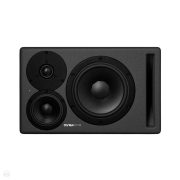
Horizontal Left-and-Right Layout
The mirrored cabinets are designed for horizontal use. Their low profile can help with positioning around a workstation, although the supporting surface should be wide and strong enough to hold each speaker securely.
Specifications
Brand: Dynaudio
Model: LYD 48
Product Type: Three-way active nearfield/midfield studio monitor
Woofer: 8-inch MSP
Midrange: 4-inch MSP
Tweeter: 1.1-inch soft dome, current product specification
Amplifier Type: Class-D, three amplifiers per cabinet
Woofer Amplifier: 80W
Midrange Amplifier: 50W
Tweeter Amplifier: 50W
Internal Signal Processing: 24-bit/96kHz
Crossover: Three-way DSP
Crossover Frequencies: 460Hz and 5.5kHz
Frequency Response: 50Hz–21kHz, published ±3dB limits at 85dB
Extended Bass Response: 40Hz–21kHz at −6dB, with Bass Extension set to −10Hz
Maximum SPL: 112dB at 1m, pair, manufacturer specification
Enclosure Type: Rear-ported bass reflex
Inputs: Balanced XLR and unbalanced RCA
Audio Outputs: None
Input Sensitivity Settings: −6dB, 0dB and +6dB
Bass Extension Settings: −10Hz, 0Hz and +10Hz
Sound Balance Settings: Bright, Neutral and Dark
Position Settings: Free and Wall
Standby Control: On or Auto
Recommended Orientation: Horizontal
Recommended Listening Distance: Approximately 1.5–2.5m
Mains Supply: 100–240V AC, 50/60Hz, current product specification
Maximum Power Consumption: 100W per speaker
Standby Consumption: Up to 0.5W per speaker
Finish Options: Black Satin and White Satin
Dimensions: 369mm W × 234mm H × 328mm D per speaker
Weight: 12kg per speaker
Manufacturer Pack Quantity: One speaker per box
Rapallo Listing Configuration: Left-and-right stereo pair
Why Buy From Rapallo
✔ Advice on choosing monitors for your workspace
✔ Help with source connections and volume control
✔ Guidance on stands and isolation
✔ Subwoofer integration advice
✔ Practical room and placement recommendations
✔ New Zealand-based product support
✔ Contact us for current finish availability and delivery options














 NZ AV specialists available to help before or after your purchase
 Over 1800 verified product reviews from genuine NZ verified purchasers
 Secure checkout & local warranty, we look after you
 NZ price match on identical products so you know you are getting the right price